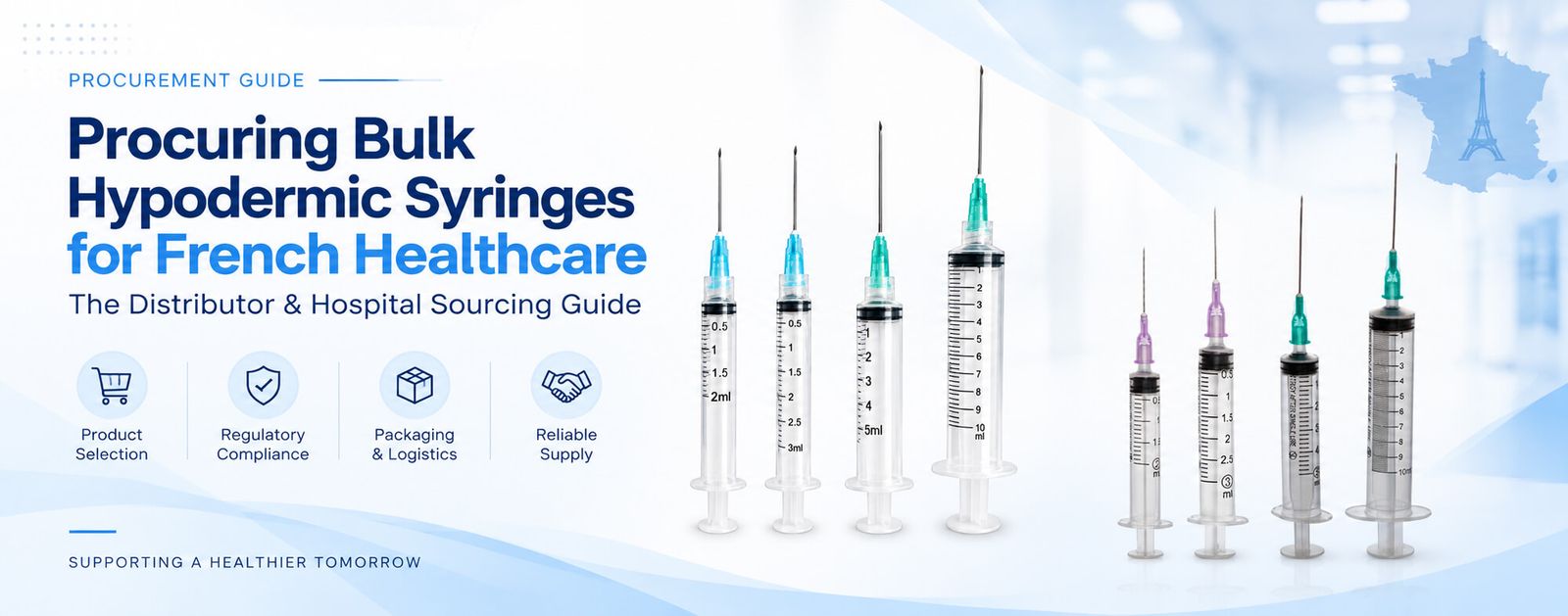
Procuring Bulk Hypodermic Syringes for French Healthcare
For French healthcare distributors and hospital procurement teams, buying hypodermic syringes in bulk involves more than comparing unit prices.
The purchasing decision should consider the syringe configuration, capacity, connection type, sterility, packaging, documentation, traceability, manufacturing controls and the supplier’s ability to maintain consistent specifications across repeat orders.
For organisations sourcing from manufacturers outside France or the European Union, regulatory responsibilities also need to be clearly understood. Under the EU Medical Devices Regulation (MDR), manufacturers, authorised representatives, importers and distributors have defined responsibilities intended to support the safety, effectiveness and traceability of medical devices throughout the supply chain.
This guide explains the main points French distributors and hospitals should evaluate before placing a bulk order for disposable hypodermic syringes.
What Should You Define Before Requesting a Syringe Quote?
A supplier cannot provide a meaningful bulk quotation unless the product specification is clearly defined.
Before sending an RFQ, specify:
- Syringe capacity
- Luer Lock or Luer Slip connection
- With or without needle
- Needle gauge and length, where applicable
- Sterile or non-sterile configuration
- Intended application
- Barrel and plunger configuration
- Graduation requirements
- Individual packaging requirements
- Secondary and master-carton packaging
- Required quantity
- Annual purchasing volume
- Required documentation
- Private-label or OEM requirements
- Target delivery schedule
For hospitals, procurement specifications should also reflect the requirements of the relevant clinical departments and the purchasing organisation’s internal product standards.
For distributors, it is useful to define whether the syringes will be sold under the manufacturer’s brand, the distributor’s private label or another commercial arrangement.
Which Hypodermic Syringe Specifications Matter Most?
1. Syringe Capacity
Capacity is one of the first specifications to define.
Depending on the product range and intended application, buyers may require different syringe sizes. The important procurement issue is not simply having multiple capacities available, but ensuring that each SKU has clearly defined specifications, consistent graduations and appropriate packaging.
A distributor supplying multiple healthcare customers should establish the exact capacity and configuration required for each SKU before requesting pricing.
2. Luer Lock vs Luer Slip
Connection type is another important purchasing specification.
Luer Lock syringes use a threaded connection designed to secure compatible components.
Luer Slip syringes use a friction-fit connection.
The appropriate configuration depends on the intended application and the requirements of the healthcare customer. A procurement specification should therefore state the required connection rather than simply requesting a generic “disposable syringe.”
LARS Medicare’s hypodermic syringe range includes both Luer Lock and Luer Slip configurations.
3. With or Without Needle
Bulk syringe procurement should clearly establish whether the syringe is supplied:
- Without a needle
- With a pre-attached needle
- With a separately packaged needle
- As part of another specified configuration
Where a needle is included, the gauge and length should be defined in the purchase specification.
This prevents a common procurement problem: receiving a syringe that technically matches the requested capacity but does not match the required needle configuration.
What Should French Buyers Check When Purchasing Syringes in Bulk?
Product consistency
A bulk order may contain thousands or hundreds of thousands of units. Consistency therefore matters across the entire production batch.
Ask the supplier how it controls:
- Barrel dimensions
- Graduation accuracy
- Plunger movement
- Connector fit
- Needle attachment, where applicable
- Packaging integrity
- Sterility
- Lot identification
- Final inspection
ISO 7886-1:2017 specifies requirements and test methods for the design of empty sterile single-use hypodermic syringes for manual use, with or without needles. The standard covers syringes intended for aspiration and injection after filling by the end user.
Samples before the commercial order
A pre-production or commercial sample should be evaluated before committing to a large purchase.
For distributors, sample evaluation can include:
- Physical dimensions
- Connection compatibility
- Graduation readability
- Plunger movement
- Packaging
- Labelling
- Product appearance
- Customer-specific requirements
Hospitals may also need to evaluate compatibility with existing clinical workflows and procurement specifications.
A sample approval process can reduce the risk of discovering specification problems after a large shipment has already been produced.
Regulatory Considerations for French Healthcare Distributors
French healthcare procurement involving medical devices falls within the EU regulatory framework.
The European Commission identifies manufacturers, authorised representatives, importers and distributors as economic operators under the MDR, with specific responsibilities applying to each role.
For distributors, Article 14 of the MDR includes checks before making a device available on the market. ANSM’s published material summarising these obligations includes verification of CE marking, the EU declaration of conformity, required manufacturer information, importer compliance where applicable and UDI requirements where applicable.
This means a French distributor should not treat regulatory documentation as an administrative formality to be requested after purchasing.
It should form part of the supplier qualification process.
Documentation to discuss with the supplier
Depending on the product and supply arrangement, buyers may need to establish the availability and applicability of:
- EU Declaration of Conformity
- CE-marking information
- Manufacturer identification
- Authorised Representative information where applicable
- Importer information where applicable
- UDI/device information where applicable
- Product labelling
- Instructions for use
- Sterilisation information
- Lot/batch traceability
- Quality-management documentation
- Relevant test or conformity documentation
The exact documentation required depends on the device, economic operator role and regulatory circumstances. Buyers should verify requirements for their specific product and supply chain rather than relying on a generic supplier checklist.
What Is EUDAMED and Why Does It Matter?
EUDAMED is the European Database on Medical Devices established under the EU medical-device regulations.
As of 28 May 2026, four EUDAMED modules became mandatory to use: Actor Registration, UDI/Device Registration, Notified Bodies & Certificates, and Market Surveillance.
The UDI/Device module is intended to improve identification and traceability of devices placed on the EU market. The European Commission states that manufacturers must submit UDI/device information for devices they place on the EU market through EUDAMED under the applicable requirements.
For French distributors, this reinforces the importance of knowing:
- Who the legal manufacturer is
- Who the importer is, where applicable
- Who the authorised representative is, where applicable
- Which device/SKU is being supplied
- How the product is identified and traced
- Whether the relevant economic operators have fulfilled their obligations
Which Standard Is Relevant to Disposable Hypodermic Syringes?
One key standard buyers may encounter is ISO 7886-1:2017 — Sterile hypodermic syringes for single use — Part 1: Syringes for manual use.
ISO currently lists ISO 7886-1:2017 as the published edition and states that it was last reviewed and confirmed in 2022. However, a new edition is currently under development.
The current standard addresses design requirements and test methods for empty sterile single-use hypodermic syringes used manually. It does not cover every type of syringe; for example, ISO identifies separate standards for insulin syringes, power-driven syringe pumps and certain other specialised configurations.
Important: An ISO standard reference should not be treated by itself as proof that a product is legally compliant for sale in France. EU market compliance involves the applicable MDR requirements and the responsibilities of the relevant economic operators.
Manufacturer or Distributor: Which Sourcing Route Should You Use?
The sourcing route depends on the buyer’s requirements.
Buying through a French or EU distributor
This can be suitable when the buyer needs:
- Local commercial support
- Smaller order quantities
- Local stock
- Faster replenishment
- Established distribution arrangements
Buying directly from a manufacturer
Direct sourcing may be considered when the requirement involves:
- Large annual volumes
- Contract manufacturing
- OEM/private label
- Custom packaging
- Long-term supply agreements
- Direct technical communication
- Export procurement
For hospitals and distributors, the important question is not simply whether a supplier calls itself a manufacturer. Buyers should verify the actual supply arrangement, manufacturing location, regulatory documentation and responsibilities of each party.
Why Should You Request Samples Before Bulk Production?
A sample gives the purchasing team an opportunity to verify the product before committing to a large quantity.
For hypodermic syringes, a sample evaluation can cover:
Physical inspection
- Barrel construction
- Plunger fit
- Graduation clarity
- Connector configuration
- Needle configuration
Packaging inspection
- Primary packaging
- Sterile barrier
- Labelling
- Lot/batch information
- Expiry information where applicable
Procurement inspection
- Carton configuration
- Quantity per carton
- Shipping dimensions
- Product coding
- Documentation
If a distributor intends to sell the syringe under a private label, artwork and labelling should also be approved before mass production.
Packaging and Logistics in Bulk Syringe Procurement
The unit price does not represent the complete procurement cost.
For large-volume orders, buyers should evaluate:
- Units per inner box
- Units per master carton
- Carton dimensions
- Gross and net weight
- Pallet configuration
- Container loading
- Storage conditions
- Shelf-life requirements
- Production lead time
- Shipping lead time
- Reorder lead time
Packaging also affects warehouse planning.
A supplier that provides clear carton quantities and dimensions allows distributors to estimate storage requirements and logistics costs before placing repeat orders.
How to Build an RFQ for a Hypodermic Syringe Supplier
A detailed RFQ makes supplier comparison easier.
Your request should include:
Product
- Disposable hypodermic syringe
- Capacity
- Luer Lock/Luer Slip
- With or without needle
- Needle specification, if applicable
- Sterility requirement
Quantity
- Initial order quantity
- Estimated annual volume
- Expected reorder frequency
Packaging
- Individual packaging
- Inner box quantity
- Master carton quantity
- Private-label requirements
Regulatory
- Applicable conformity documentation
- CE information
- EU Declaration of Conformity
- UDI/device information where applicable
- Manufacturer and economic-operator information
Commercial
- MOQ
- Unit price
- Tooling or artwork costs
- Sample availability
- Production lead time
- Payment terms
- Incoterms
- Shipping origin
A structured RFQ reduces the chance of comparing different products under the same generic description.
Sourcing Bulk Hypodermic Syringes from LARS Medicare
LARS Medicare lists Hypodermic Syringe among its medical disposable product portfolio and provides sourcing options for distributors, importers, bulk procurement and hospital sourcing.
Its dedicated hypodermic syringe page lists Luer Lock and Luer Slip configurations and states that the company offers OEM/private-label supply. The company also states that its syringe products are CE and ISO 13485 certified; buyers should obtain and review the applicable product-specific documentation for their intended EU market supply arrangement.
LARS Medicare Hypodermic Syringe Range
For larger procurement requirements, LARS Medicare’s enquiry process allows buyers to specify annual volume, product requirements and quote type, including bulk procurement and hospital sourcing.
LARS Medicare Product Catalogue
Common Mistakes When Buying Disposable Syringes in Bulk
1. Comparing only the unit price
A lower quoted price may not represent a lower total procurement cost if packaging, freight, documentation, MOQ or lead times differ.
2. Asking for a “standard syringe”
There is no useful procurement specification in the phrase alone.
Capacity, connection, needle configuration, sterility and packaging should be defined.
3. Skipping sample approval
A large order should not be based solely on a catalogue photograph or specification sheet.
4. Ignoring repeat-order consistency
The supplier should be able to explain how specifications and quality are controlled across production batches.
5. Treating ISO certification as the entire compliance assessment
ISO 13485 certification and product-specific standards are important elements of supplier qualification, but they do not replace the applicable EU regulatory requirements.
6. Leaving packaging until the end
Packaging affects labelling, storage, logistics and private-label production. It should be defined before production starts.
Frequently Asked Questions
How do I choose a hypodermic syringe supplier in France?
Define the required syringe specification first, then evaluate suppliers based on product documentation, regulatory responsibilities, quality systems, samples, production capacity, packaging, lead time and commercial terms.
Can French hospitals buy hypodermic syringes directly from an overseas manufacturer?
The supply arrangement must comply with the applicable EU MDR requirements and clearly establish the responsibilities of the manufacturer, authorised representative, importer and distributor where applicable.
What information should I send when requesting a bulk syringe quotation?
At minimum, provide syringe capacity, Luer configuration, needle requirement, sterility, quantity, packaging, annual volume, regulatory documentation requirements and delivery location.
What is the difference between Luer Lock and Luer Slip syringes?
Luer Lock uses a threaded connection, while Luer Slip uses a friction-fit connection. The required configuration should be selected according to the intended application and customer specification.
What standard applies to disposable hypodermic syringes?
ISO 7886-1:2017 is the published international standard covering sterile single-use hypodermic syringes for manual use, with or without needles. ISO is currently developing a replacement edition.
Does ISO 7886-1 alone prove compliance for the French market?
No. It is a technical standard relevant to the product, while EU market access also involves the applicable MDR requirements and economic-operator responsibilities.
Can LARS Medicare supply hypodermic syringes in bulk?
LARS Medicare states that it supplies disposable hypodermic syringes to hospitals, clinics and medical distributors and offers bulk orders, samples and OEM/private-label options.
Final Procurement Checklist
Before approving a bulk hypodermic syringe supplier, confirm:
- Correct syringe capacity
- Luer Lock or Luer Slip confirmed
- Needle configuration confirmed
- Sterile/non-sterile requirement confirmed
- Product specification approved
- Sample evaluated
- Packaging approved
- MOQ confirmed
- Annual supply capacity discussed
- Production lead time confirmed
- Shipping terms confirmed
- EU regulatory documentation reviewed
- Manufacturer identified
- Importer/authorised representative responsibilities established where applicable
- UDI/traceability requirements addressed where applicable
- Batch/lot documentation confirmed
- Private-label artwork approved, if applicable
Prepare Your Bulk Syringe Sourcing Request
For French distributors and hospital procurement teams, the most efficient approach is to begin with a precise product specification rather than a generic request for “disposable syringes.”
Define the syringe configuration, volume, connection type, needle requirements, packaging, annual demand and regulatory documentation requirements. Then request samples and a detailed quotation from qualified manufacturers.
For buyers evaluating direct factory supply, LARS Medicare provides a dedicated Hypodermic Syringe range and accepts enquiries for bulk procurement, hospital sourcing and OEM/private-label requirements.