
For a French medical distributor, choosing an overseas IV cannula supplier is not simply a matter of comparing the unit price. The real procurement cost depends on minimum order quantities, packaging, pallet utilisation, freight, customs clearance, regulatory documentation and the supplier’s ability to maintain consistent specifications from one shipment to the next.
This matters particularly when you buy IV cannulas in bulk in France from a manufacturer outside the European Union. A quotation that looks competitive at factory level can become less attractive once freight, import formalities, handling and inventory requirements are included.
A practical supplier assessment should therefore begin with the complete supply chain rather than the product price alone.
What French Distributors Should Check Before Choosing an IV Cannula Supplier
An overseas supplier should be evaluated against the requirements of the French market and your own distribution model.
Start by requesting:
- Product specifications and available gauges
- Sterile packaging configuration
- Primary and secondary packaging details
- Minimum order quantity
- Carton quantity and dimensions
- Pallet configuration
- Production lead time
- Estimated shipping transit time
- Export documentation
- Regulatory documentation applicable to the device
- Available OEM or private-label options
- Shelf-life and batch information
- Lot traceability arrangements
- Commercial terms and Incoterms
The purpose is to establish the landed cost and operational requirements before approving a supplier.
Check the MOQ Against Your Actual Sales Volume
Minimum Order Quantity is one of the first commercial questions to ask.
A supplier may quote a lower price for a large production run, but a French distributor should calculate whether the quantity can realistically be sold before stock approaches its expiry period. Large orders can also tie up working capital and increase warehouse requirements.
Ask the manufacturer whether MOQ is calculated:
- Per SKU
- Per gauge
- Per packaging configuration
- Per private-label artwork
- Per total order
- Per production batch
This distinction can materially change the practicality of an order.
For example, a distributor may require several IV cannula gauges but have different demand levels for each. A single MOQ applied independently to every gauge can create unnecessary inventory.
Packaging: Look Beyond the Box Quantity
Packaging configuration directly affects purchasing, storage and freight calculations.
French distributors may encounter quotations based on boxes of 50 or 100 pieces, while some manufacturers use different inner-box and master-carton configurations. Neither configuration should automatically be considered better. The relevant question is whether the packaging fits your sales volume, warehouse system and downstream customers.
Request a packaging specification showing:
| Procurement detail | What to confirm |
|---|---|
| Inner box | Pieces per box |
| Intermediate pack | Boxes per pack, if applicable |
| Master carton | Total pieces per carton |
| Carton dimensions | Length × width × height |
| Gross weight | Weight per carton |
| Net weight | Product weight |
| Pallet | Cartons per pallet |
| Pallet dimensions | Overall loaded dimensions |
| Pallet weight | Gross shipment weight |
This information allows a distributor to calculate warehouse capacity and freight costs before confirming the purchase.
Do not assume that a product supplied in a 50-piece box will necessarily have a lower logistics cost than one supplied in a 100-piece box. The master-carton dimensions, number of cartons per pallet and total shipment volume can be more important than the inner-box quantity.
Pallet-Level Planning Can Reduce Surprises
Once the order reaches pallet quantities, the discussion should move from unit price to shipment economics.
Ask the medical disposables supplier for a palletisation diagram or written pallet configuration. Confirm how many cartons fit on each pallet and whether mixed SKUs are permitted.
For a distributor purchasing multiple IV cannula gauges, mixed-SKU palletisation can sometimes be commercially useful, but it must be agreed with the manufacturer before production.
The buyer should know:
Units → boxes → cartons → pallets → total shipment weight and volume
That sequence provides a much clearer picture of the actual procurement requirement.
Shipping Lead Time: Separate Production From Transit
“Delivery time” is too vague for an international medical-device purchase.
Ask the supplier to separate:
- Order confirmation
- Artwork or specification approval, where applicable
- Production lead time
- Quality-control release
- Packing
- Export documentation
- Port or airport handling
- International transit
- Customs clearance
- Final delivery in France
This prevents a common procurement mistake: treating the manufacturer’s production lead time as the total delivery period.
A supplier may be able to manufacture an order within a stated number of working days, but the final arrival date also depends on the chosen transport method, shipping schedule, customs processing and the delivery location in France.
For recurring orders, ask the supplier whether production slots can be planned in advance. A distributor with predictable demand may benefit from a rolling forecast instead of repeatedly placing urgent orders.
Customs Clearance for Medical Devices Entering France
When medical devices are imported from outside the EU, customs and regulatory requirements need to be considered together.
French Customs identifies medical devices as goods subject to restrictions and import/export controls. Its guidance states that, subject to exceptions, devices imported from a third country must carry the appropriate CE marking and be accompanied by a declaration of conformity.
The French importer should therefore establish responsibility for customs and regulatory documentation before shipment.
An EORI number is also relevant to businesses importing or exporting goods outside the European Union. French Customs provides an EORI verification service for customs operations.
Documents to Discuss With the Supplier
Depending on the transaction and product, the purchasing team should establish which documents will accompany the shipment.
These may include:
- Commercial invoice
- Packing list
- Transport document
- Certificate of origin, where required
- Declaration of conformity
- Relevant conformity or certification documentation
- Product specifications
- Batch or lot information
- Sterilisation information where applicable
- Other documents requested by the importer or customs broker
The exact document set should be confirmed with the French importer, customs broker and relevant regulatory representatives for the specific device.
Do Not Treat CE Marking as the Entire Regulatory Assessment
A French distributor should verify the regulatory status of the specific device and the responsibilities of each economic operator.
Under the EU Medical Device Regulation framework, manufacturers, authorised representatives, importers and distributors have defined responsibilities. The European Commission specifically notes requirements relating to safety, effectiveness and traceability throughout the supply chain.
The EU framework also uses UDI-related identification and EUDAMED to support identification and traceability. The European Commission states that EUDAMED became mandatory for use from 28 May 2026 for the applicable registration processes described by the Commission.
For a French distributor, the practical lesson is simple: regulatory documentation should be reviewed during supplier qualification, not after the goods have been manufactured.
Why Factory-Direct Sourcing Can Be Useful
Direct manufacturer sourcing can give distributors more control over product specifications, packaging and commercial quantities.
For example, a distributor may want:
- Multiple IV cannula gauges
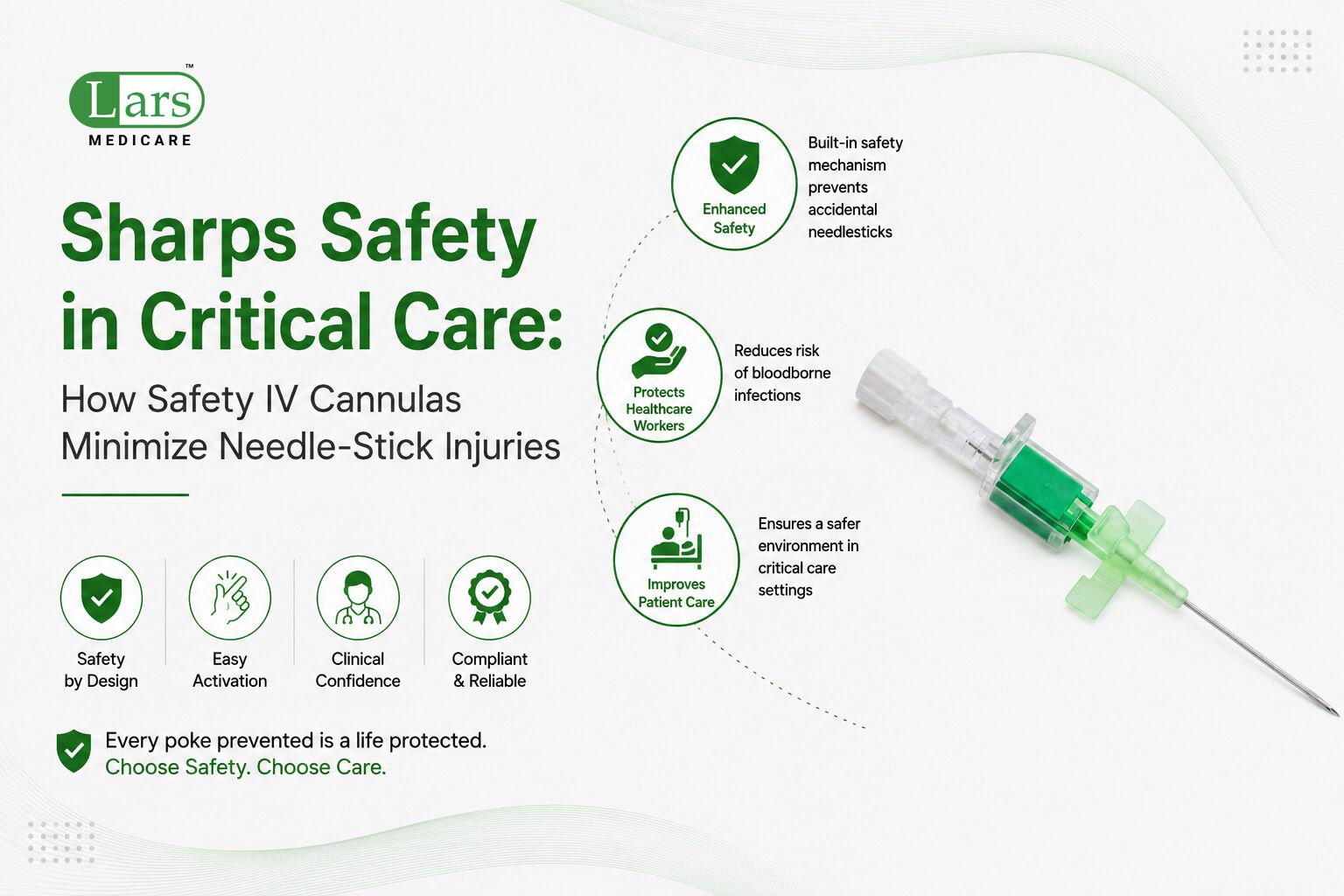
- Safety IV cannula options
- Custom packaging
- Private-label products
- Several related infusion products
- Consolidated shipments
- Repeat production schedules
Lars Medicare publishes a range including conventional IV cannulas and safety IV cannula products, along with OEM and private-label supply options.
Its published Provein™ range includes several gauges from 14G through 26G, with different lengths and flow specifications. Buyers should nevertheless confirm the exact current specification and regulatory documentation for the model intended for the French market before ordering.
Questions to Send an IV Cannula Supplier Before Ordering
A French procurement team can use the following checklist when requesting a quotation:
Product
- Which IV cannula models are available?
- Which gauges and lengths are available?
- What is the exact product reference?
- What is the sterile shelf life?
- What packaging configuration is available?
Quantity
- What is the MOQ per SKU?
- Is mixed-gauge ordering possible?
- Is there a different MOQ for OEM or private-label production?
Packaging
- How many pieces are packed in each inner box?
- How many boxes are in one master carton?
- How many pieces are in one carton?
- What are the carton dimensions and weights?
- How many cartons fit on one pallet?
Production
- What is the production lead time?
- How long does quality release take?
- Can repeat orders be scheduled against a forecast?
Shipping
- Which Incoterms are available?
- What is the estimated shipment volume?
- What is the gross shipment weight?
- Which transport modes are available?
- Which export documents are supplied?
Regulatory
- What conformity documentation is available for the exact product?
- Who is the authorised representative where applicable?
- What information is required from the French importer?
- How is batch and lot traceability maintained?
Getting these answers in writing makes supplier comparison substantially easier.
A Practical Landed-Cost Calculation
The purchase price should not be the only number in the procurement spreadsheet.
A distributor can structure its calculation as:
Landed cost = product cost + packaging/customisation + freight + insurance where applicable + customs charges + import taxes/VAT treatment + customs-broker/handling costs + inland delivery
The actual treatment depends on the transaction, product classification, origin, Incoterm and applicable French/EU rules. The customs broker should verify the applicable tariff classification and import charges for the specific product.
This calculation can reveal why a slightly higher factory quotation may produce a similar or different landed cost once the complete shipment is considered.
Choosing a Supplier for Long-Term Distribution
For a distributor building a recurring supply relationship, the supplier evaluation should extend beyond the first quotation.
Review whether the manufacturer can support:
- Consistent product specifications
- Repeat production
- Multiple gauges
- Stable packaging
- Batch traceability
- Regulatory documentation
- Forecast-based purchasing
- OEM or private-label requirements
- Export documentation
- Communication during production and shipment
Lars Medicare identifies itself as a manufacturer of IV cannulas and other single-use medical devices and publishes manufacturing and export information for international buyers.
For any current procurement project, however, distributors should request the latest certificates and product-specific regulatory documents rather than relying only on general statements published online.
FAQ
How do I find an IV cannula supplier in France?
French distributors can source from domestic suppliers or evaluate manufacturers outside the EU. When considering an overseas manufacturer, compare the complete landed cost, MOQ, product documentation, packaging, shipment configuration and regulatory responsibilities.
Can I buy IV cannulas in bulk for distribution in France?
Yes, bulk purchasing is a standard B2B procurement approach, but the order should be planned around SKU demand, MOQ, shelf life, warehouse capacity and pallet configuration.
Should I choose boxes of 50 or 100 IV cannulas?
There is no universal answer. Compare the unit packaging with master-carton dimensions, pallet capacity, customer requirements and total logistics cost. Ask the manufacturer for the complete packaging hierarchy before deciding.
What documents should I request from an overseas medical-device manufacturer?
At minimum, establish which conformity, product, commercial, packing and shipping documents are required for the specific device and import transaction. The French importer and customs broker should confirm the final documentation requirements.
What is more important: MOQ or unit price?
Neither should be assessed in isolation. A low unit price attached to an unnecessarily large MOQ can increase inventory and working-capital costs. Evaluate the price against expected consumption, shelf life and the complete landed cost.
Can French distributors request OEM or private-label IV cannulas?
Some manufacturers offer OEM or private-label programmes. The feasibility normally depends on product specifications, regulatory requirements, artwork, packaging and order volume. These points should be agreed before production.
Final Procurement Checklist
Before placing an initial order with an overseas IV cannula manufacturer, make sure you have confirmed:
- Exact product and SKU
- Gauge and length
- Sterile packaging
- Pieces per box
- Cartons per pallet
- Carton dimensions and weight
- MOQ
- Production lead time
- Shipping method
- Incoterm
- Importer responsibilities
- Customs documentation
- Regulatory documentation
- Batch traceability
- Shelf life
- Total landed cost
For French distributors, this approach turns supplier selection from a simple price comparison into a practical supply-chain assessment. The objective is to know exactly what will arrive, in what quantity, with which documentation, at what logistics cost and within what timeframe before the purchase order is released.